UK DAILY GOSSIPS

UK HOTTEST GOSSIPS NEWS

Breaking

Showing posts with label HEALTH. Show all posts

Monday, October 29, 2018

October 29, 2018

Climate change is 'escalator to extinction' for mountain birds


Scientists have produced new evidence that climate change is driving tropical bird species who live near a mountain top to extinction.
Researchers have long predicted many creatures will seek to escape a warmer world by moving towards higher ground.
However, those living at the highest levels cannot go any higher, and have been forecast to decline.
This study found that eight bird species that once lived near a Peruvian mountain peak have now disappeared.
Researchers are particularly concerned about tropical mountain ranges and the impacts of climate change.
"The tropical mountain areas are the hottest of biodiversity hotspots; they harbour more species than any other place on Earth," lead author Dr Benjamin Freeman from the University of British Columbia told BBC News.
"It's only got a little bit warmer in the tropics and tropical plants and animals seem to be living quite a bit higher now than they used to."
The species that live in these regions are also hugely vulnerable because the difference in temperatures between lower and higher elevations in tropical regions is not as great as it is in other parts of the world. This means that moving up the slopes may not be as much of a solution for species in the tropics as it is elsewhere.
To test these ideas, scientists carried out a survey in 2017 of bird species that lived on a remote Peruvian mountain peak.
The team covered the same ground, at the same time of year, and used the the same methods as a previous survey, carried out in 1985.
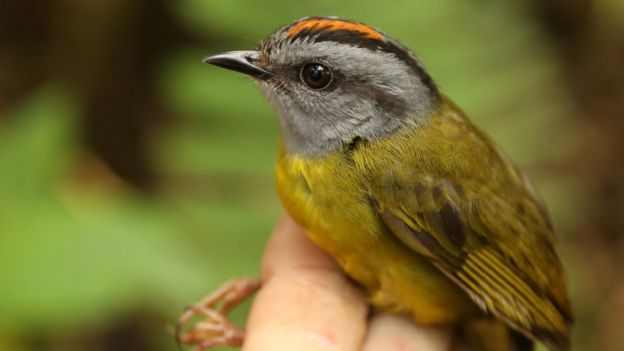
birdImage copyrightGRAHAM MONTGOMERY
Image captionA russet-crowned warbler
They found that on average, species' ranges had shifted up the slope between the two surveys. Most of the species that had been found at the highest elevations declined significantly in both range and abundance.
The researchers say that recent warming constitutes an "escalator to extinction" for some of these species with temperatures in the area increasing by almost half a degree Celsius between the two surveys.
Of 16 species that were restricted to the very top of the ridge, eight had disappeared completely in the most recent survey.
"These birds have moved up the mountain as much as you'd predict if temperature was this master switch that controlled where they live," said Dr Freeman.
"The ones that lived near the top 30 years ago are gone."
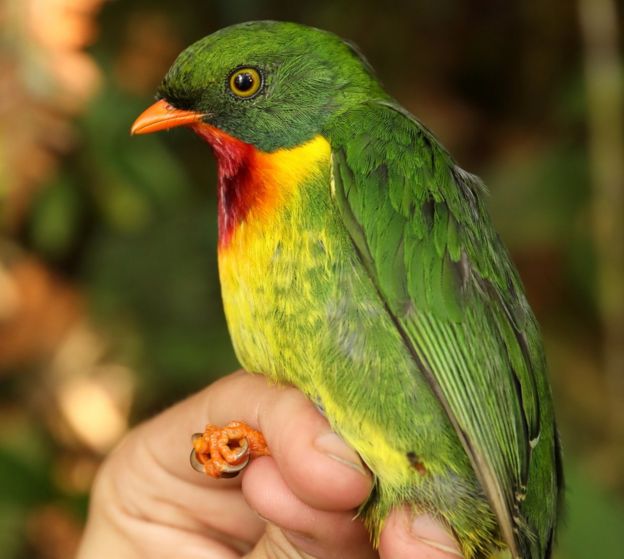
birdImage copyrightGRAHAM MONTGOMERY
Image captionA scarlet-breasted fruiteater which inhabits high elevations on the Cerro de Pantiacolla in Peru
The authors warn that rising temperatures will continue to drive widespread "extirpations and extinctions" of high-elevation animals and plants across the tropical Andes mountains.
In contrast, the scientists found that bird species living in lowland areas were benefitting from climate change, expanding their ranges, and shifting their upper limits further up the mountains.
However, even the species that are now on the move may find that they run out of options over time.
The authors say that if global temperatures rise this century between 2.6C and 4.8C, this could push tropical species a further 500m to 900m up the the slopes. This might prove too far for some.
Another problem is that many mountains have been cleared of their forests which limits the capacity of species to move up at all.
"You really can't ignore this process if you are thinking of long-term biodiversity and conservation in these areas," said Dr Freeman.
"The way to deal with it is to maintain protected habitat corridors that stretch across large elevational gradients."
The study has been published in the Proceedings of the National Academy of Sciences.
Source: 

Wednesday, October 3, 2018

October 03, 2018

Processed meat 'linked to breast cancer'

Regularly eating foods like bacon and sausages may raise the risk of breast cancer, according to researchers.
A review of studies found women who ate high levels of processed meat had a 9% increased risk of the cancer compared with those who ate little of it.
The study backs up previous findings of the World Health Organization, which says processed meats cause cancer.
Experts recommend caution about the findings and say the actual risk for individual women is "very small".

How reliable are the findings?

This review, which included data on more than a million women, shows a link between processed meat consumption and breast cancer risk, but it's not clear if the food is actually causing this.
There are also other pitfalls to consider.

The 15 studies used in the analysis had different definitions of the highest consumptions.
For example, one of the UK studies in the review classed high consumption as more than 9g a day - the equivalent of just two or three rashers a week - while in others it was much higher.
The researchers in the majority of these studies noted what people said they ate and followed them up to see which of them developed breast cancer.

But the problem with this is that people who eat different amounts of processed meat may also have other behaviours that might explain the differences in breast cancer risk, such as being more or less healthy in other ways.

What is the risk?

In the UK about 14 out of every 100 women will get breast cancer at some point in their lives.
That means a 9% increase in risk in this population would be expected to translate into roughly one extra case of cancer in every 100 women.
Cancer Research UK estimates that about 23% of breast cancers are preventable.
It estimates that about 8% of cases are caused by being overweight and obese and another 8% by alcohol.

Authors of this study, published in the International Journal of Cancer, say the link they found is only for processed meat, not red meat.
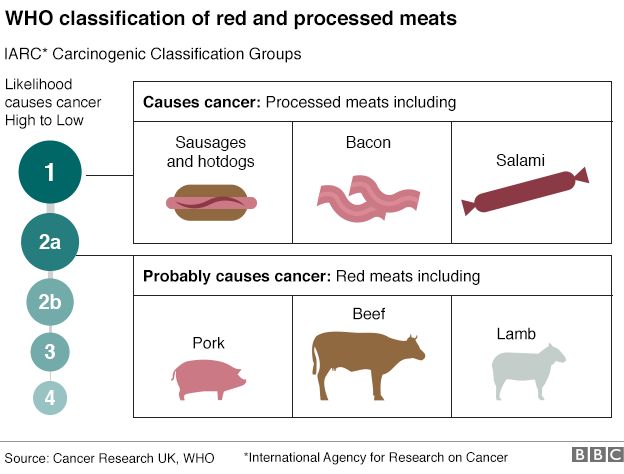
The WHO lists processed meat as carcinogenic, primarily because of evidence linking it to a raised risk of bowel cancer, while it says red meat is "probably carcinogenic".

What is processed meat?

Graphic: Classification of red & processed meat products
Processed meat has been modified to either extend its shelf life or change the taste, usually by smoking, curing, or adding salt or preservatives to meat.
This includes bacon, sausages, hot dogs, salami, corned beef, beef jerky and ham.
There are different theories for why it may raise the risk of cancer, including that curing salt may react with protein in the meat to make it carcinogenic.

So should we cut out processed meat?

Lead author Dr Maryam Farvid, of the Harvard TH Chan School of Public Health in the US, recommends cutting down on the meat rather than eliminating it.

Currently, the NHS recommends eating no more than 70g of red and processed meat a day.
Dr Gunter Kuhnle, associate professor in nutrition and health at the University of Reading, who was not involved in the study, said it was "questionable" whether people should lower their red and processed meat consumption on the back of this study.
He said the actual risk posed by processed meats was "very small" for the individual and more relevant on a population-wide level.

However, he said the study's findings should be followed up to investigate the links between processed meat and cancer and see whether the associated risk could be reduced, for example through new food production methods.

Source: bbc news

Monday, September 24, 2018

September 24, 2018

Venezuela crisis: Chinese hospital ship docks for a week

A Chinese hospital ship has docked in Venezuela, where for the next week it will provide free health care to local patients.
Venezuela's Defence Minister Vladimir Padrino López, went to the port of La Guaira to welcome the Chinese crew.
He said that the Peace Ark's visit was agreed by President Nicolás Maduro during a visit to Beijing last week.
Venezuela agreed at the time to increase its exports of oil to China, which is one of its main creditors.
Venezuela's economic crisis has led to severe shortages of food and medicines and the collapse of public services.
Venezuela's Defence Minister Vladimir Padrino Lopez (R) attends the arrival ceremony of the China's People's Liberation Army (PLA) Navy hospital ship Peace Ark at the port in La Guaira, Venezuela September 22, 2018.Image copyrightREUTERS
Image captionVenezuela's Defence Minister Vladimir Padrino Lopez (right) has praised China's gesture
The opposition says the presence of a Chinese hospital ship in Venezuela shows the extent of the humanitarian crisis.

'True diplomacy'

Mr Padrino López thanked China for the gesture of friendship and said that both countries would benefit.
"It is a pleasure to have this ship in Venezuela, which has arrived here after travelling to more than 40 countries" he said.
"This is how true diplomacy is done: with concrete cooperation actions," added Mr Padrino López.
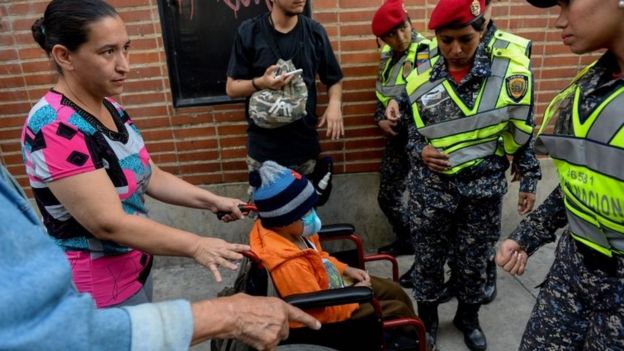
A woman pushing a wheelchair with a child at a health workers protest outside the "Dr J M de los Rios" Children's Hospital in Caracas 16 August 2018.Image copyrightAFP
Image captionThe shortage of medicines and poor working conditions have led to health workers protests
The Venezuelan government blames an international boycott led by the United States for Venezuela's economic crisis.
On Friday, US Secretary of State Mike Pompeo promised to unveil "in the coming days" a series of actions against "Venezuelan leadership folks".
President Donald Trump has previously called President Maduro a dictator and accused his government of illegally detaining, beating up and killing opposition activists.
Hundreds of thousands of people have fled the country over the past year, as the crisis worsened.
According to United Nations figures, 2.3 million people left Venezuela between 2014 and June 2018.
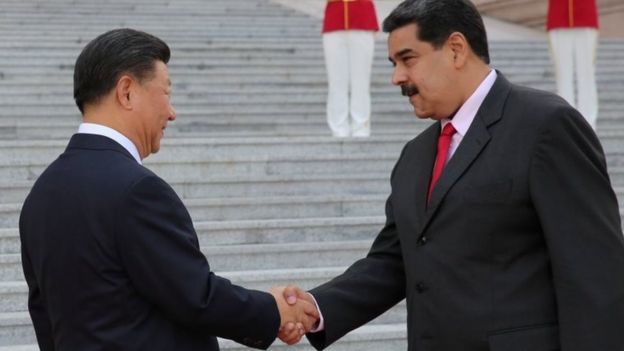
Chinese President Xi Jinping and Venezuela's President Nicolás Maduro shake hands during his welcoming ceremony in Beijing, 14 September 2018.Image copyrightREUTERS
Image captionChina's President Xi Jinping and Mr Maduro met in Beijing earlier this month
Mr Maduro travelled to China last week, looking for support to help rebuild the economy.
He said he had signed 28 trade and investment deals with China.
Venezuela said it would increase oil exports to 1 million barrels a day.
The two countries also agreed to invest $5bn (£3.8bn) to help rebuild Venezuela's ailing oil industry.
But there was no public statement from Beijing saying it had agreed to provide new funds to Mr Maduro's government.

Wednesday, September 12, 2018

September 12, 2018

Enhanced flu jab to save 'hundreds of lives'

An enhanced flu jab for elderly people will save hundred of lives this winter, according to Public Health England.
Flu is far more dangerous in old age.
The effectiveness of flu jabs notoriously declines as people get older and was effective in just one in 10 over-65s last winter.
The enhanced vaccine that will be given this year contains extra ingredients designed to help aged immune systems develop a stronger defence against flu.
It is hoped the "adjuvanted vaccine" will help ease pressures on the health service.
Public Health England estimates the vaccine will lead to:
Prof Paul Cosford, from Public Health England, told the BBC: "This looks like it is going to be is a significant improvement and quite a step in our battle against flu each winter."
The vaccine will also be offered to the over-65s in Wales and Northern Ireland as well as the over-75s in Scotland.

New developments

The over-65s vaccine will protect against three strains of flu, but people under 65, in the so-called at-risk groups, will be offered a vaccine that protects against four types of flu.
At-risk groups include pregnant women and those with long-term health conditions.
Meanwhile, the childhood vaccination programme will be expanded so children from age two up to Year 5 in primary school are offered a flu nasal spray.
Children are seen as flu "super-spreaders" - in part due to worse hygiene - so the childhood programme is designed to protect both children and anyone they come into contact with.
In total, 24 million people in England will be offered the flu vaccine - 3 million more than last winter.
But a major sticking point for health officials remains the roughly one-in-three NHS staff who do not get vaccinated.
Prof Cosford said staff had a "professional duty" to be vaccinated to protect their patients.
Prof Jane Cummings, chief nurse for England, said up to half of flu cases had no symptoms so she expected staff to be vaccinated.
She said: "Faced with the worst flu season in a decade, NHS staff last winter did a remarkable job providing care for patients.
"This year, the public will be better protected from flu than ever before, with at-risk groups being offered the most effective vaccine available and every member of NHS staff expected to get their jab."
Chief medical officer, Prof Dame Sally Davies said: "Getting the flu vaccine is the single best way to protect yourself against this potentially fatal illness, and this year, the NHS is offering it to 24 million people across the country.
"In addition to this - a newly available vaccine that is more effective will be offered to over-65s. This could prevent hundreds of deaths and save thousands of GP and hospital hours - I strongly encourage everyone in vulnerable groups to get the life-saving vaccine as we head into winter."
Source: bbc
September 12, 2018

Women 'struggling to access contraception'

Doctors are warning that contraceptive access is at a "crossroads", with services being cut across England.
Figures seen exclusively by the BBC show half of councils have cut, or plan to cut, services, particularly affecting long-acting contraception.
Leading reproductive health consultant Dr Asha Kasliwal has warned this may be a factor in rising abortion rates in older women.
The Department of Health says local councils allocate their health budgets.
Through Freedom of Information requests, the Advisory Group on Contraception obtained data suggesting that almost half of all councils in England have closed, or plan to cut, the number of sites providing contraception services between 2015 and 2019.
The AGC contacted all 152 local authorities in England, with 74 (49%) saying they have reduced, or plan to reduce, the number of sites commissioned to deliver contraceptive services in at least one year between 2015/16 and 2018/19.
While the most widely accessible form of contraception is condoms, and the most commonly prescribed the contraceptive pill, increasing numbers of women are asking for long-acting forms of contraception - like the coil and implants.
These are more effective than the pill and the most popular form of contraception for older women - and recommended by the NHS.
Between 2014 and 2016, three-quarters of councils in England had reductions in long-acting reversible contraceptives (LARCs) being fitted by GPs and walk-in clinics because fewer GPs had the time or training to fit them, leading to women increasingly having to seek appointments at sexual health clinics.

Progress 'under threat'

Dr Louise Skioldebrand is one of only a handful of GPs still carrying out fittings in Stowmarket, Suffolk.
She said: "There are only a certain number of GPs who are trained to fit coils and implants. We have a six-week waiting time. I think there's a real risk that unplanned pregnancies will go up. I would guess in a year's time, we will have more."
Prof Helen Stokes-Lampard, chair of the Royal College of GPs, said: "It's extremely concerning to hear of such large-scale cuts, or plans to cut, contraceptive services, across England - actions that will potentially affect millions of women.
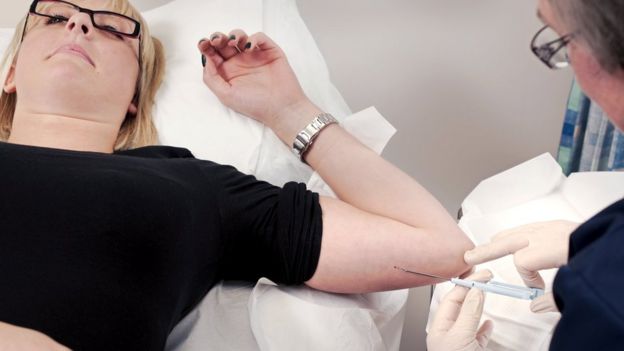
Woman having an implant fittedImage copyrightSCIENCE PHOTO LIBRARY
Image captionAccess to long-acting contraception - like implants - is particularly affected.
"It seems bizarre when there is strong evidence that investing in good contraception services is one of the most cost-effective healthcare interventions available."
She added: "It's also incredibly frustrating, because we've actually had years of improvement in the quality of sexual and reproductive healthcare in the UK; we've seen teenage pregnancy rates halved; we've seen take up of LARCs increasing.
"But the most recent data shows prescriptions for LARCs - reliable, cost-effective contraception - decreasing.
"We're at a crossroads, whereby all the progress we've made is under serious threat, and we fear it will be some of our most vulnerable patients who are affected most."
Prof Lampard said the way sexual and reproductive health services were organised was too fragmented. And she said the college was aware of GPs who had been running LARC-fitting clinics, but not being adequately funded to do so.
Dr Kasliwal, president of the Faculty of Sexual and Reproductive Healthcare which represents 15,000 doctors and clinicians, added: "My concern is that the unmet need (for contraception) might get translated into unplanned pregnancies and possibly the increased abortion rates that we are seeing today.'

'Choices available'

Lisa Hardin from Northampton had an unplanned pregnancy while taking the contraceptive pill last year. After her daughter's birth, she wanted to get an implant, but her GP had stopped fitting them so she had to go to a clinic.
"I had to wait another two months until I actually got my implant in - but no-one thinks, for three months, what are you supposed to do in the meantime? I was so worried about getting pregnant."
The Department of Health and Social Care says it is up to local councils to allocate the public health budget - including funding for contraception services.
"We have a strong track record on sexual health - sexually transmitted infections continue to fall and teenage pregnancies are at an all-time low.
"A wide range of contraceptive choices are available free of charge from most GP surgeries, community contraceptive clinics and sexual health clinics."
Source:bbc

Friday, August 31, 2018

August 31, 2018

New asthma treatment set for wider NHS distribution


A new treatment for severe asthma is set to be made more widely available on the NHS in the UK by the end of 2018.
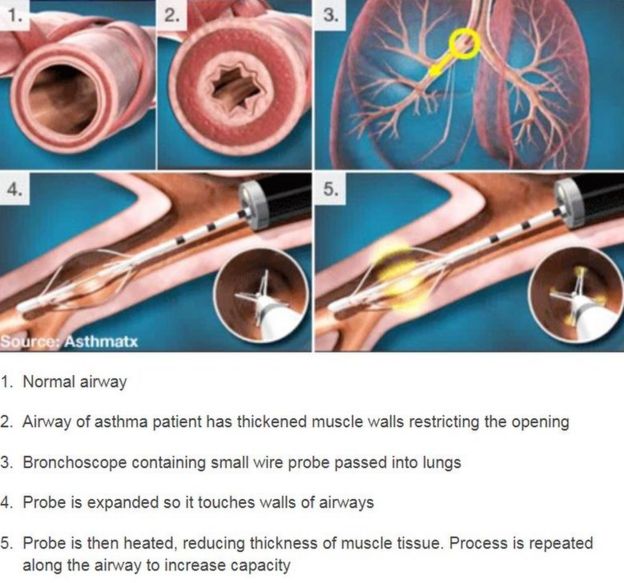
The procedure, bronchial thermoplasty, "melts" away excess muscle tissue in the lungs using radio frequency, making breathing easier.
Previously there were strict criteria about who was eligible to receive it.
But the National Institute for Health and Care Excellence (Nice) says it can be offered more routinely, after it was proved to be safe and effective.
Some people may still not be able to receive it because the final decision about whether to offer the procedure lies with local health bodies.

Who could benefit?

Some 5.4 million people in the UK have asthma - but for more than 200,000 of them (3.7%) the asthma is so severe, it can be life-threatening.
In fact, the most recent figures from Asthma UK show that 1,410 people died from asthma in 2016.
However, this "life-changing" treatment will be used only if a patient's symptoms cannot be adequately controlled with drugs, and is only suitable for adults.
Joe Farrington-Douglas, the charity's head of policy and external affairs, said: "This debilitating form of asthma is resistant to regular treatments, meaning many have to cope with terrifying asthma symptoms, such as gasping for breath, as well repeated trips to Accident & Emergency.
"Until now, this treatment has only been available for specific patients at some specialist centres, but these new guidelines could mean more people with the condition could reap the benefits."
Presentational grey line

Symptoms of asthma

  • Coughing
  • Wheezing
  • Shortness of breath
  • Chest tightness
They might only happen when you react to a trigger, like pollen, dust, cigarette smoke, cold air or pets.
Source: Asthma UK
Presentational grey line

How does it work?

Severe asthma causes inflammation and constriction of the smooth muscle in the walls of the small tubes - the bronchi - impeding the passage of air through to the deep tissue of the lungs.
Bronchial thermoplasty tackles this by reducing this muscle mass, thus decreasing the constriction of the bronchi that can take place during an asthma attack.
As a result, patients experience fewer and less severe asthma attacks.
The procedure takes place under sedation or general anaesthetic and involves a wire probe being inserted into the lungs.
Diagram of bronchial thermoplastyImage copyrightASTHMATX/BBC
Image captionDiagram of bronchial thermoplasty
Ten-second bursts of radio waves are sent along the airway wall, heating the lining of the lungs to 65C.
Two further sessions will be needed, each three weeks apart.
The estimated cost of the procedure per patient is thought to be between £7,099 and £7,257.
Nice's programme director and clinical adviser, Prof Kevin Harris, said: "This is a procedure which is innovative and it does work.
"Asthma is a common disease and the vast majority of patients won't require this treatment.
"But for people with severe asthma this procedure could be life-changing.
"The committee was convinced it was safe enough and works well enough for use with standard arrangements in the NHS."
Source: bbc.co.uk
August 31, 2018

Shropshire baby and mother maternity deaths review widened


An independent review into a series of baby deaths at a hospital is to be expanded after more families came forward with concerns about their care.
In 2017 Jeremy Hunt ordered an investigation into maternity care relating to 23 cases at the Shrewsbury and Telford NHS Trust (SaTH).
The Health Service Journal (HSJ) reported that "at least 60 deaths" had been identified in total.
But SaTH said it had reviewed a further 40 cases and contacted 12 families.
Senior midwife Donna Ockenden was appointed last year to review 23 cases - including baby deaths, maternal deaths and brain injuries - of alleged poor maternity care at the trust.
A spokesperson for NHS Improvement said it had to agreed "to consider additional historical investigations that have been highlighted since our independent review was announced in April 2017, where women, infants and new-born babies had died or suffered harm in the maternity services provided by Shrewsbury and Telford Hospital NHS Trust".
"This includes the cases that the trust had considered as part of its legacy review, as well as the finding of the review it commissioned the Royal College of Obstetricians and Gynaecologists to undertake."
Richard Stanton, 48, whose daughter Kate Stanton-Davies died nine years ago, said: "It doesn't surprise me, it deeply saddens me."
He welcomed the move to bring all the investigations under the umbrella of the Ockenden review, so there could be "consistency" with cases looked at "with the same eye".
"In my view, there's serious questions for the leadership, management, governance and policies at this trust, as it's been a systemic failure."

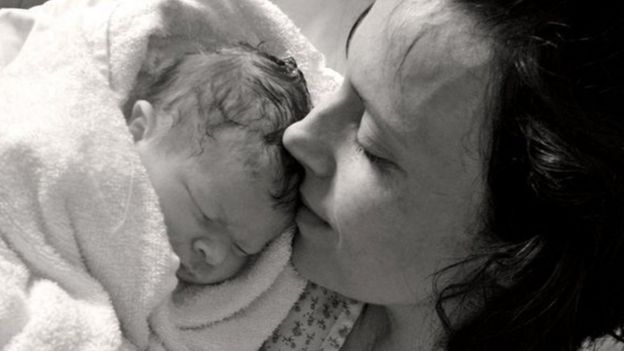
Kate Stanton-Davies photographed with her mother, RhiannonImage copyrightRICHARD STANTON
Image captionKate Stanton-Davies, pictured with her mother Rhiannon, was born at Ludlow Community Hospital

Hayley Matthews's son Jack Burn was born in March 2015 but died of hypoxia and Group B Strep within hours.
She said that throughout her 36 hour-long labour at the Princess Royal Hospital in Telford she was refused a caesarean section several times and had a natural birth during which her son's shoulder was trapped.
"It makes you angry, all these parents going through what I went through three years ago. They said changes have been made but at the moment we're failing to see any," she added.
"I was just another number on a bed."

SaTH said it had reviewed 40 cases, 23 of which had no signs of failure of care and five of which the families could not be contacted.
It said it had also written to 12 other families to seek permission for their care to be reviewed as there "may be potential for further learning".
The trust's chief executive Simon Wright added: "The death of any baby is a terrible ordeal for any family. We take our responsibilities in reviewing these cases very seriously.
"To suggest that there are more cases which have not been revealed when this is simply untrue is irresponsible and scaremongering."
Powys Community Health Council said the issue would be "worrying" for people in the county who used the services.
In a statement it said: "Since concerns were first raised, the Community Health Council has sought assurance from Powys Teaching Health Board that the services they commission for Powys residents are safe."
A Department of Health and Social Care spokesman said: "We take any patient safety concerns extremely seriously - we have asked NHS Improvement to investigate whether further cases at Shrewsbury and Telford should be considered as part of the Ockenden Review, as well as assurance that the Trust has taken steps to improve maternity services since these issues came to light in 2016."
source:bbc.co.uk